Showing posts with label reading comprehension. Show all posts

Monday, September 14, 2026

Say It. Take It Apart. Learn It.

How we rebuilt the terminology tools in Anatomy & Physiology, 12th Edition.


Ch 49 opening page with Language of Science word list on right. Caption: Say it. Take it apart. Learn it.

An A&P course is partly a language course.

Okay, it's a huge language course.

Our students encounter hundreds of unfamiliar terms, many of them long, difficult to pronounce, and constructed from word parts they've never seen before. And we're asking students to learn all that new language while simultaneously learning some pretty challenging concepts.

That's why Anatomy & Physiology has long provided terminology-learning tools that you may not find—or may not find in the same depth—in other A&P textbooks.

For our new 12th Edition, we decided those tools deserved a major tune-up.

And that's how Frank got himself into trouble.


A word list with a job


At the beginning of each chapter, we provide a chapter word list.

It's comprehensive. The list gathers all the boldface terms from the chapter narrative, along with an occasional italicized term when we think it's useful to include it.

That gives students one convenient place to preview the important language of the chapter.

But these aren't intended simply as "vocabulary words that might be on the test."

I've previously explained the idea in Word Lists Help Students Build Their Mental Lexicons.

One useful way to prepare for reading an A&P chapter is to scan its terminology before digging into the narrative. That gives the reader a chance to start becoming familiar with the words before trying to understand the concepts they represent.

Learning research gives us good reason to think about new vocabulary this way. Becoming familiar with a word involves developing connections among how the word is written, how it sounds, and what it means.

That's one reason I don't want students meeting carbaminohemoglobin cold in the middle of an already complicated explanation of blood-gas transport.

Give the poor student a fighting chance.


Say it


Our chapter word lists include a simple phonetic pronunciation guide for each term, along with an embedded hint instructing the reader how to use it.

The comprehensive Glossary does, too.

That lets students practice saying a term before encountering it within a sentence that's already asking them to understand some new anatomical or physiological idea.

Yes, I actually encourage students to say the terms aloud.

I've been beating that drum for years—in Word Lists Help Students Build Their Mental Lexicons, in The A&P Professor podcast Episode 20, Reading A&P Terms Out Loud Helps Reading Comprehension, and again in Episode 145, A Tongue Twister's Guide to Mastering Anatomy Pronunciation.

There is learning science behind my nagging.

Research on what's called the production effect has repeatedly found that saying words aloud can improve later memory for them compared with simply reading them silently. One leading explanation is that producing the word makes its memory more distinctive.

Does that mean saying carbaminohemoglobin three times will suddenly make you understand blood-gas transport?

Nope.

But the term can begin to "sound right" in the learner's mental lexicon. When it later appears in a sentence, the reader has one less completely unfamiliar thing to wrestle with while trying to understand the actual A&P.

That can be especially helpful for readers who aren't yet very comfortable predicting the pronunciation of unfamiliar English words.

Which, when you think about English pronunciation, could be just about anybody.

graphic stating "Say it. Take it apart. Learn it."


Why not put the pronunciation right in the sentence?


Some textbooks put pronunciation guides immediately after a term the first time it appears in the narrative.

There's an obvious advantage to that: the pronunciation is sitting right there when the reader needs it.

But we chose a different approach.

A beginning A&P learner is already trying to hold unfamiliar structures, processes, relationships, and vocabulary in mind while making sense of a sentence. Dropping a phonetic pronunciation guide into the middle adds another piece to process—and interrupts the flow of an explanation that may already be challenging.

We'd rather give students the pronunciation before they read.

And if they need it again, it's waiting in the chapter word list or Glossary.

I should be clear that I don't know of research directly comparing our approach with inline pronunciation guides in A&P textbooks. That's our application of what we know about reading, vocabulary learning, memory, cognitive load, and our experience watching beginning A&P students wrestle with unfamiliar terminology.


Take it apart


Pronunciation is only part of the job.

Most A&P instructors I know are constantly taking terms apart for their students.

Hyper- means above.

Hypo- means below.

Cardi- refers to the heart.

-itis means inflammation.

We do this almost without thinking.

Why?

Because once students start recognizing commonly used roots, prefixes, and suffixes, an intimidating scientific term becomes a lot less intimidating.

Our chapter word lists support that approach by showing useful word parts and their basic translations. Students can skim them while previewing a chapter.

Our Glossary provides those same kinds of clues when students look up terms later.

I've discussed this strategy before in Word Parts Help Students Master the Language of Science and Handy Supplement Helps Students Master the Lingo of A&P.

Word parts can act as little mnemonic clues. They may help students remember the spelling and meaning of a term.

More importantly, each familiar word part becomes another tool students can carry forward. When they encounter a term they've never seen before, they can often begin taking it apart and making an educated guess about what it means.

That's a skill they'll keep using in later courses and eventually in clinical settings.

And isn't that exactly what we A&P professors already do?

We point out word parts during lectures and discussions. We explain them in handouts and assignments. We keep reminding students that this bit means one thing and that bit means another.

The difference is that our chapter word lists give students a complete, consistent resource that's always handy.

Research on morphological learning—learning to recognize and use meaningful word parts—supports its usefulness in building vocabulary. A 2023 study with college learners, for example, found that explicit morphological training improved receptive academic vocabulary learning. The National Library of Medicine likewise teaches medical terminology by having learners identify prefixes, roots, suffixes, and other components and use them to work out meanings of unfamiliar medical terms.

Anatomy-specific research has also found benefits from explicitly teaching Latin and Greek etymologies alongside anatomical terminology

No, learning a pile of Greek and Latin roots isn't a magic shortcut to mastering A&P. Research with undergraduate A&P students has found only a weak relationship between their existing knowledge of Greek and Latin roots and overall course performance.

That's fine.

We're not trying to turn the chapter word lists into a Latin course.

We're giving students another tool for figuring things out.


Names change, too


Another part of our terminology cleanup involved continuing a transition we've been making for years: moving farther away from eponyms as our preferred anatomical terms.

An eponym names something after a person. Islets of Langerhans, haversian canal, and fallopian tube are familiar examples.

Eponyms remain deeply embedded in clinical language, and our students are going to encounter many of them. So we don't pretend they don't exist.

But international efforts to standardize anatomical terminology have long favored standardized descriptive terminology rather than eponyms as the preferred names for structures. Clinical usage has not always moved at the same speed.

So our general approach is practical: teach students the currently preferred descriptive terminology while helping them recognize important alternate terms they'll still hear and read elsewhere.

I've written about some of this before in What's Up with Eponyms in A&P? Part 1 and What's Up with Eponyms in A&P? Part 2.

And yes, at the end of Part 2 I promised a Part 3.

In 2018.

I really ought to get back to that.

Especially because A&P faculty still have some pretty lively disagreements over what we should do with eponyms. We had a few of those discussions within the Patton Team, too.

Or what passes for lively disagreement among us.

More about that another time.

graphic stating "Terminology isn't extra"


Then Frank got the job


All of this sounds fairly straightforward until you realize how many terms we're talking about.

And how many pieces each entry has.

Which term should be preferred?

Which alternate terms should remain?

Is the pronunciation accurate?

Is it consistent with similar terms elsewhere in the book?

Are the syllables and word parts divided appropriately?

Are their translations useful to a beginning learner?

Does the formatting make the entry easier to understand?

Now multiply that by an entire A&P textbook.

Then remember that our revision team included four authors, at least three editors, and a collection of reviewers, copyeditors, proofreaders, compositors, and others.

Having all of us independently "fix" terminology seemed like an excellent recipe for making it less consistent.

Clearly, we needed one person to wrangle the whole thing.

Author Frank Bell, our in-house terminology guru, seemed like the obvious choice.

I vaguely recall that Frank was absent from the weekly Patton Team meeting when his name came up as the perfect person for the job.

Pure coincidence, I'm sure.

When the news reached him, Frank didn't hesitate.

Much.


A global terminology cleanup


Frank took on a global review of the terminology resources for the entire book.

And it turned out to be a much bigger job than any of us anticipated.

Besides reviewing the terminology itself against current usage and authoritative sources, he went through the pronunciation guides, word parts, translations, and formatting.

Occasionally, Frank would come back to me with a question such as, "Why did you do it this way?"

That's always a fun question for an author who has been revising a textbook for decades.

Sometimes I could explain the original thinking.

Sometimes the answer was probably some variation of, "Well, I'm sure there was a reason."

With that background, Frank could decide whether the original approach still made sense—or whether he had found a better one.

Once Frank completed his review, the other authors incorporated his terminology changes throughout the chapters and other elements being revised.

Then editors checked us.

Then copyeditors checked us.

Then proofreaders checked us.

And, as always, despite all that checking, I'm sure somebody will eventually find something we missed. That's what happens in a project containing thousands upon thousands of tiny details.

But this is by far the most systematic and consistent terminology review we've ever done.


And there's the Glossary


As I mentioned in the first post of this series, The A&P Textbook You May Have Overlooked, we've moved our large Glossary from the back of the printed textbook to the Evolve Student Resources.

That helped us make the physical book noticeably shorter without taking this resource away from students.

The Glossary is more comprehensive than the chapter word lists. It includes all the boldface and italicized terms from the text narrative, plus some additional terms that students encounter only in figures or tables.

And it reinforces the same learning tools students encounter in the chapter word lists.

How do I say this term?

What useful word parts can I recognize?

What do those parts mean?

So a student can preview terminology in the chapter word list, encounter it while learning the chapter's A&P, and return to it later in the Glossary.

Same language. Same system. Same tools.


Our best terminology tools yet


When Frank finally emerged from beneath the mountain of terminology, the 12th Edition had the most carefully reviewed and internally consistent collection of A&P terms, simple pronunciations, and useful word-part translations we've ever produced.

Having looked at the terminology resources available in the other A&P textbooks we examined, I suppose I could claim that ours is the best A&P terminology collection in the universe.

I'm not going to claim that.

But I think I could.

What I will claim is that we worked very hard to make these resources accurate, consistent, easy to use, and genuinely useful to beginning A&P learners.

Terminology isn't something we add around the edges of an A&P course.

It's the language students need to learn the course.

So we think it's worth getting the words right.

If you'd like to explore these terminology resources yourself, request a free instructor review copy of the new 12th Edition of Anatomy & Physiology.

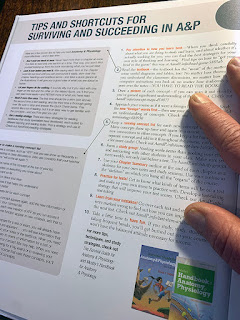
Thursday, March 10, 2022

Tips and Shortcuts for Surviving and Succeeding in A&P

A feature of Patton Anatomy & Physiology that is often overlooked by faculty, but loved by beginning anatomy and physiology students is called 

Tips and Shortcuts for Surviving and Succeeding in A&P.

As soon as an A&P student unwraps and opens their new textbook, they flip over that endpaper and find this one-page guide on how to get started on the path to success. That one page is loaded with great study tips and how-to-read-a-textbook guidance organized in an intuitive, graphic manner. 

From metacognition to tackling new terminology to retrieval practice, this guide uses simple language to quickly outline the key strategies needed to succeed in A&P.

This guide also give faculty a place to quickly send students asking for study advice. And it gives faculty a place to find quick and easy tips for them to share in class or in a syllabus or course website.

Embedded throughout each chapter are brief Hints that remind students to use these strategies just at the moment they need them. Read more about these Hints at Embedded Hints Improve Reading Comprehension.

Patton Anatomy & Physiology is a textbook that is truly focused on helping students succeed!


Tuesday, March 6, 2018

New Unit Pre-Tests Help Jump-Start Student Learning

A particularly exciting update in the new edition of Anatomy & Physiology is the new learning feature in the opening of each unit of the book.

Recall that A&P is chunked into more, smaller chapters than other 2-semester A&P textbooks to reduce a reader's cognitive load while learning. This improves both the reader's engagement with the book, making them more likely to actually read it, and the overall ability to learn from it. These small chapters are grouped into six logical units, mapped out in the color-coded list on the first page of the book (facing the cover) that corresponds to the color tabs visible on the page edges.

In previous editions, the unit-opener page had a listing of the chapters within that unit plus a brief introduction to the "story" of the unit. I have now expanded that into a two-page spread that also includes a brief pre-test to get students engaged in the upcoming topics.

Learning science shows that pre-tests help jump-start student learning. Long used solely to measure students' prior knowledge, pre-tests have demonstrated their own ability to enhance learning outcomes—even if teachers never look at the scores. I have found this to be profoundly true in my own A&P teaching.

The concept and design of our new unit openers was worked out by textbook learning guru Michael Greer, veteran A&P teacher Terry Thompson, and myself. Terry then worked in consultation with me and our editors and book designers to execute the final versions.

Students will see just a few illustrated questions that help students refresh learning from prior chapters that they'll need when reading the new unit, along with questions that preview new concepts they'll encounter. Such pre-testing "primes the pump" by getting them thinking about key concepts ahead of their reading. And it sets the stage for connecting new learning with prior learning.

Readers get immediate feedback on the accuracy of their answers by using the answer key printed sideways along the page edge.  Just like in a magazine quiz, eh? That ensures that they're not accidentally remembering the wrong answer as they read.

Readers also get an embedded hint that tells them why the pre-test is there (to jump-start their learning).

Of course, our students may just skip the unit openers. So we need to tell them about it. Continued and emphatic reminders of the value of these pre-tests in making their reading and learning easier is a key to its role in student success in our course.


Wednesday, May 13, 2015

Embedded Hints Improve Reading Comprehension

Can we assume that our students come to us already knowing how to read a book? Probably. 

Can we assume that they know how to effectively read and use an A&P textbook? Probably not.

Really? you may wonder. What's special about reading a textbook?

Technically detailed textbooks such as A&P textbooks are not much like books of popular literature. One cannot just sit down and read a chapter of an A&P textbook from start to finish—like you would with a novel—and expect to have learned much. And whatever you did comprehend would probably disappear from your brain by day's end.

No, college reading experts tell us that students must use reading strategies to comprehend what they read in a textbook. But I see that my students come to me without any such strategies or skills. They've gotten by without them until they hit their A&P textbook, then wonder why the textbook doesn't seem to be helping them much. Then they limp along on class notes only—missing out on the deeper learning possible with the complementary material in the textbook.

I was an excellent reader when I was an undergraduate. Looking back, however, I realize that I didn't use any special strategies—and I didn't really get a whole lot out of my hours of textbook reading. Not compared to what happens now when I do technical reading employing some of the proven strategies to increase my reading comprehension of technical scientific works.

So what to do? Spend a week teaching our students how to read their textbooks? After getting some training ourselves in college reading strategies?

I've provided a better option in Anatomy & Physiology.

To guide students step by step through an effective reading strategy, I've embedded a series of hints that tell students exactly what to do to learn from their textbooks more effectively—and by spending less total study time.

Some of these strategies I've discussed here in previous posts. For example, I've already walked you through the word-study approach to reading vocabulary and The Big Picture summary of interrelationships of concepts.

Take a look at any chapter in Anatomy & Physiology to see the embedded hints clearly marked with the Hint icon. If you don't have a copy, just go to this link and request a free review copy now!

Then let's help our students by advising them follow the directions in the hints to get the most out of their A&P textbooks—and reduce their total study time!

Wednesday, May 6, 2015

Case Studies Promote Critical Thinking Skills

The use of case studies in teaching is probably as old as teaching itself. What better way to solidify the learning of basic concepts than to practice applying them to hypothetical "real life" scenarios?

The teaching and learning of human anatomy and physiology lends itself particularly well to case study applications. Most of our learners are preparing for health professions or fitness-athletic careers in which they'll be doing nothing but applying A&P principles to real-life cases.

That's why every chapter in Anatomy & Physiology includes a brief, engaging Case Study scenario that challenges the reader to apply what they've learned in that chapter. It appears with the end-of-chapter review material, as part of a suite of active learning opportunities that help readers really "get" the core concepts of human structure and function.

Brain -based learning principles hold that students learn better when they are challenged with activities that allow them to construct and consolidate their own mental models of basic concepts. Puzzling over a case study after reading a chapter helps students do just that.

I've found that many of my A&P students rely heavily on inductive reasoning and therefore may find that case studies make it easier to understand core concepts. The chapter narrative uses a deductive approach, moving from general principles to specific concepts—then the case study turns things around a bit and allows the reader to explore specific cases to construct a mental framework of the broader principles. They thus learn their A&P "backward and forward," eh?

Study after study has shown that the case-study strategy is an effective learning tool for A&P students, so why not incorporate that into their reading process?

Take a look at the Case Studies in your copy of Anatomy & Physiology to see that it really does fit the needs of your students to improve reading comprehension. If you don't have a copy, just go to this link and request a free review copy now!

X-ray credit: Hellerhoff

Wednesday, April 15, 2015

Tables Help Students Recognize Patterns

One of the things our Anatomy & Physiology books are known and loved for is their extensive set summary tables. Although students quickly discover how useful they are, I'm not sure many A&P professors give them much thought.  But as an A&P author, I have to give them a lot of thought—and I want to share a few of my thoughts about these tables that may surprise you!

Tables help students construct a conceptual framework.
Sometimes, beginning students are so overwhelmed with details that they have a hard time seeing how it all fits together into a whole idea. Summary tables bring details together in a way that assists learners in starting their own cognitive scaffold for new facts and ideas. Those of us who already appreciate "the big picture," often forget how critical it is for newbies to properly build their understanding in steps.

Tables serve as a handy reference tool.
Students often use their textbooks for "raiding" specific facts, rather than reading whole sections.  For example, when learning the bones and markings of the skeleton, summary tables can quickly and effectively give a pithy description of illustrated structures in the textbook. As professors, we often forget how much the beginner relies on such tools to get started in learning.

Tables help students recognize patterns.
Many of the tables in an A&P textbook are not meant to be memorized.  Instead, they are used to compare and contrast ideas in a visual way that is difficult to do in the text narrative.  This moves students beyond "just the facts" to how those facts can be applied in understanding human structure and function.  In a table, patterns become obvious and critical thinking starts to "click" in the minds of readers. We instructors, who have already had our "aha" moments with these topics, sometimes don't appreciate how helpful a carefully arranged table can be in producing such moments.


Tables must be easily readable.
This may seem too obvious a fact to mention here. However, I've found that well-prepared teachers can easily read and understand even a horribly formatted, vaguely written table. Students who are just learning the concepts often get lost as they go across a row and don't know enough to figure out where they are supposed to look next.  Which brings me to my final, and perhaps most important, point . . .

Effective tables are carefully designed.
This is what makes a table easily readable—thoughtful design. In the latest revision of Anatomy & Physiology, effective table design is a major focus.  Having experimented in previous editions, I collaborated with our designer, editors, and previous students, to find a format that is both "readable" and "raidable."  I'll list a few things we did to make that happen in a moment.  But first, I also want to mention that I also put a lot of work into making sure that content that lends itself to a summary table is put into a table in way that complements and supports the text narrative.  That is, the table content is not simply a re-hash of the text—it is a thoughtful rearrangement of concepts to add more depth to student learning.

Table design features that promote effective learning in Anatomy & Physiology:

  • Background screens
    • Different shades of color behind different rows of each table helps the brain quickly see logical groupings of concepts.  
    • The color of the screens is apparent, but not too bright or too saturated to distract the brain from the content
  • Rules (borders)
    • White horizontal rules are just visible enough that they (along with the color screens) subtly guide the reader's eye across rows
    • Vertical rules help the reader clearly distinguish columns and cells so that it is clear how the concepts are organized in the table
  • Fonts
    • Font sizing allows tables of a compact size—which allows ease of seeing patterns in the whole—but is still big enough for easy reading
    • Intentional use of boldface and italic headings within the more complex table help clarify the organization of ideas—thus reducing the cognitive load of understanding table content
    • The occasional use of color fonts helps highlight conceptual patterns
      • For example, the book's color code can be applied in tables related to blood vessels (oxygenated red and deoxy blue) or nerves (afferent blue and efferent red)
  • Illustrations
    • Judicious use of small, embedded or nearby sketches help students more clearly "see" the concepts listed in a table
    • This is a careful balancing act, because tables with overly large illustrations, too many illustrations, or very complex illustrations can reduce the effectiveness of a table
There is lot more to what goes into designing each table in Anatomy & Physiology to make it an effective learning tool.  But this post is already almost too much to read in one sitting, eh? In later posts, I'll be calling attention to particular tables—especially those new to the latest edition—to give examples of how effective they are for deep student learning.


Wednesday, March 11, 2015

Helping Students See the Big Picture

Teaching thousands of anatomy and physiology students over the decades has taught me that a major hurdle is being able to see the "big picture" of the structure and function of the human body.

Because the A&P course necessarily includes a nearly overwhelming collection of detailed, technical facts expressed in a language that is foreign to many beginning students, they become so focused on each bit of information that they have hard time putting it all together into a coherent conceptual framework.  

One approach would be to present a concept map—or some type of graphic representation—of all the core concepts of each body system.  For example, a graphic showing how the system explored in a particular chapter ties into the structure and function of all the other systems of the body.

I think a graphic approach can be very useful, but I wonder if that strategy isn't better used as an active learning exercise in which each learner creates their own concept map—perhaps after some of the initial learning of a topic has already taken place.  Or, even better, make it a collaborative study project among a group of peers. 

I think a better approach in a textbook with limited page space is to build a "big picture" perspective into the narrative of the story.  So that's why in Anatomy & Physiology we have included a highlighted section at the end of each chapter that briefly pulls the reader back from the details of the chapter and widens the focus to take in a bigger, more global perspective.

Called The Big Picture, this feature does several things:
  • It calls the reader's attention to a whole-body, integrated view of the current topic's place in the wider scheme of human structure and function.

  • It gives specific examples of  how the current topic relates to—or builds upon—concepts covered in previous chapters.  This encourages students to integrate new concept with their growing framework of of knowledge to construct a solid  understanding of A&P.

  • This feature also looks ahead to concepts of later chapters by mentioning how the current topic will lead to a fuller understanding of concepts yet to be explored in the A&P course.

  • It improves reading comprehension of each chapter by calling attention to the main themes and reminding the reader of core concepts within a meaningful context.

  • The Big Picture specifically relates the current topic such core principles as homeostasis and form-fits-function.

  • Besides outlining specific examples of connections among concepts, The Big Picture also asks students to think about the integration of concepts themselves—thus encouraging them to develop the critical thinking skills needed to take their A&P learning forward into later courses (and into their professions).

To get the reader's attention, a one-page introduction called Seeing The Big Picture faces the first page of Chapter 1 of Anatomy & Physiology.  This feature grabs the readers attention immediately and sets them along their path already looking for the big picture.  It encourages students to think about relationships as they read—but also tells them to look for The Big Picture at the end of each chapter to help them "get" the big ideas of the chapter.

We have given a lot of thought to which strategy works best to help readers understand whole-body relationships. We are certain that the tried-and-tested summary narrative The Big Picture works well in stimulating critical thinking and construction of a solid conceptual framework than a pre-constructed chart that may short-circuit the learning process in a learner's mind.


Wednesday, February 11, 2015

Word Parts Help Students Master the Language of Science

You can't really learn and experience what's going on in your world until you can use the language.

In an A&P course, most students don't come in as native speakers of scientific terminology. Even if they know what roots, suffixes, and prefixes are, most of them don't know the literal meanings of "meta," "juxta," "reno," or "cyto." If they pick up these word parts as they learn, however, they can quickly get comfortable with the language of A&P—and really ramp up their learning of core concepts.

In Anatomy & Physiology, we have woven language learning into every chapter so that students can more efficiently master the language of A&P.

Nearly every A&P teacher I know mentions word parts frequently in class discussions—especially when introducing the more convoluted terms that represent important concepts.

Besides breaking down impossibly long words into easily consumed, bite-sized pieces, it's also a stealthy strategy to "sneak in" some language learning. Without having to "put it on the test" we can introduce word parts— and how they are used to construct phrase-like terms—in a way that allows natural language learning. Students often don't even realize that our repeated mentioning of the meaning of common word parts is adding to their mental lexicon. Soon they start recognizing these word parts on their own.

When students know what common word parts mean, they start using them as mnemonic tools (memory aids). They find themselves using the word parts as clues to remember the actual working definition of the term—and the essence of the concept that the term represents.

In Anatomy & Physiology, we support this widely used classroom approach in several ways. A central strategy is our inclusion of word parts in the chapter word lists.

In a recent post, I described our chapter word lists and explained how previewing unfamiliar words before reading a chapter helps to get those words into the reader's mental lexicon more quickly—and how that, in turn, improves reading comprehension. See Word Lists Help Students Build Their Mental Lexicons. Because we also include word parts in the chapter word lists, scanning these lists naturally builds competence in scientific language.

A widespread and effective strategy in teaching reading skills—from elementary school to advanced courses in college reading efficiency—is often called word study. In a nutshell, word study instruction encourages readers to strengthen their recognition of word patterns as first step, rather than simply memorizing new words as they encounter them. This is based on the fact that we read words and phrases as a whole.  It's one of many brain-based strategies of learning that translate current concepts of neuroscience into practical strategies.

Incorporating word parts in the chapter word list, where they can be scanned before reading the chapter, offers the opportunity for readers of Anatomy & Physiology to make the word study method part of their overall reading strategy. By building pattern-recognition skills, readers can better get new terms into their mental lexicon and thus be able to read them without stumbling and thus learn concepts more efficiently.

But wait! There's more! In Anatomy & Physiology, we provide even more built-in tools to help students gain skill in using their new language.  In my next post, I'll point these out.


Wednesday, February 4, 2015

Word Lists Help Students Build Their Mental Lexicons

When I was an undergraduate, I thought word lists that I encountered in a textbook were worthless. Besides that, I thought they were kind of middle-schoolish—something you'd see in a sixth-grade geography book.

But back then, I was an "okay" student with excellent reading comprehension skills who didn't realize that I could do much better in less time. 

Once I learned something about teaching and learning—especially some of the newer concepts coming out of the brain-based learning movement—I've changed my tune about word lists in college textbooks.

Sure, they can be used like we're in sixth grade: as a checklist of vocabulary words that are likely to show up on a test. But now I know that there is a much more powerful use of word lists: building the A&P lexicon in my brain so I can more easily understand what I read.

Although neuroscientists are still working out the minute details of how we read and remember things, we've come a long way on that front in the last few years. One thing that seems clear is that we have a sort of lexicon (word list) in our mind.

When we see, hear, and speak words, those words get onto our word lists—WHETHER WE KNOW WHAT THEY MEAN OR NOT. Come on, you recognize words all the time that you know you've seen and heard before but have little or no idea what they mean yet. That's okay. That's the necessary first step toward learning the meaning—and really owning the term.

In fact, you know that this is a necessary step before an infant can learn to speak their native language, or before a child or adult can speak or read in a second language. One has to hear the words before one can take the first steps in actually understanding and using the language. Babies who do not hear language spoken around them—regardless of any meaning—cannot learn to speak and use language naturally and efficiently.

What does this have to do with word lists in textbooks? Reading experts have long advised college students to enhance their reading of technical texts by reading all the boldface terms in a chapter OUT LOUD before actually reading the chapter. Why? Because that gets the words into the lexicon in our brains so that we are primed to learn the meaning of the term—and truly own it—when we later encounter it in reading.

To make that proven process more effective in Anatomy & Physiology, I have included word lists in each chapter. These word lists, which start at the beginning of each chapter, allow readers to quickly read through all the boldface terms as a list, rather than trying to hunt them down in the narrative over many pages of the chapter.

To make this work even better, I've included a simple pronunciation key for each term. Neuroscientists and reading experts alike tell us that getting a pronunciation right from the get-go is essential for success in getting terms into our mental lexicons and making them readable. Because we read whole words—not letters or word parts—recognizing a term with which we have already linked a pronunciation is clearly a vital step.

If we don't have a good pronunciation of a word, we can't recognize it easily—and eventually learn its meaning—when we run across it again in our reading. Without having a handle on the pronunciation, a term like carbaminohemoglobin might as well be καρβαμινοαιμοσφαιρίνης.

Some textbooks include pronunciation guides in-line—that is, as the term appears in the text narrative. That makes sense only because that's what we're used to. It does not make sense when you know how the brain reads and comprehends. Such in-line pronunciation keys fail in at least two important ways.

First, they are too late. The recognition of the letter combination as a unit (a word) and linking that with "how it sounds" in our head and in our ear has to be there BEFORE we encounter it reading.

The second problem with in-line pronunciation keys is that they are big bumps in the road. As we read along, stopping even occasionally to read a pronunciation key to see if we've got it right is a huge disruption to our train of thought. In fact, it often derails our train of thought and we have to go back and restart the section if we really want to understand what's going on. It may not SEEM like a big deal, because perhaps we're used to such bumpy roads and mangled railroad tracks, but it really does disrupt the thinking of a reader already struggling with understanding complex concepts using complex terminology.

Because of thoughtful formatting of fonts in the chapter word lists in Anatomy & Physiology, readers can use the pronunciation keys or not.  Some students already have some of the language—but many do not.

In Anatomy & Physiology I tell readers (in the HINT at the top of each chapter's word list) to pronounce each word out loud before reading the chapter. I realize that many will ignore this advice and skip right to the text narrative. My students (and my children) ignore my hard-won, experience-based advice all time. I've gotten used to it.

But for the few A&P students who take my advice, or take YOUR advice to them, this technique really works. How do I know it works? My A&P students who have taken this advice while using the 7th and 8th editions of Anatomy & Physiology have reported great success with it. I guess those neuroscientists and reading experts are right, eh?

In my next post, I'll address some other helpful aspects of the chapter word lists.


Monday, December 1, 2014

Paper Perfect


There are so many things to consider when focusing on the readability of a textbook.  Paper is one of them.

Having had the experience of working in my dad's print shop as a kid, I learned at a young age that not all papers are alike.  Some are thick and stiff and others are thin and flexible.  Some are glossy and some are matte.  There are many different types of paper—each with its own characteristics.


One characteristic of book paper that can affect readability is the finish.

Glossy finishes are great for photographs because the bolder colors seem more saturated.  Glossy finishes also increase contrast between similar colors and thus can make a color photo seem just a bit sharper. Creating a coffee-table book of your favorite butterfly photos?  Use thick, glossy paper.

Color photos printed on matte-finish don't "pop" quite as much as on glossy paper.  But matte paper reduces glare, so a reader usually finds it easier to see details in color photos and illustrations—an important issue for learning anatomy. Reduced glare is also known to reduce reading fatigue.  Making it more likely that students will be able to read the book without getting a headache.

In Anatomy & Physiology we use a paper that doesn't have the glossy sheen found in some A&P textbooks.  We instead use a finish that maximizes readability by minimizing text-obscuring glare—thus reducing reading fatigue. Maybe the photos don't "pop" quite as boldly as they could, but readers can easily see each and every detail.

For A&P textbooks, a matte finish on a thin, opaque body (to reduce the total weight) is ideal for reading and exploring details of anatomical illustrations.

Who'd have thought that part of making a book highly readable is picking just the right paper?  It turns out that little details like that can make a big difference in learning!


Cartoon:adapted from Raúl Ruano Ruiz
Photo: K Patton

Monday, November 24, 2014

Chunking Chapters - By The Numbers

I recently outlined my rationale for chunking textbook chapters into smaller bits. In the article Reducing Text Anxiety, I explain that breaking large chapters into smaller chapters improves reading comprehension.  Learning experts call this "reducing cognitive load" and both expert and poor readers benefit by shorter chapters. Now let's look at the numbers behind this chunking.

Comparison to the Previous Edition

As the first table shows, the average chapter length of the new edition of Anatomy & Physiology has dropped by a whopping 23% without changing the length of the textbook.  Likewise, the longest chapter in the book is now 19% shorter than the longest chapter in the previous edition.

A&P/8e
A&P/9e
Difference
Total (chapters)
37
48
+11
Total (pages)
1140
1140
same
Average (pages/chapter)
30.8
23.8
- 23%
Shortest chapter (pages)
16
12
-25%
Longest chapter (pages
52
43
-19%

Comparison to Other A&P Textbooks

The second table compares a few other 2-semester A&P textbooks to the new edition of our Anatomy & Physiology.  At an average chapter length of only 24 pages, our chapters are about 12 pages (33%) shorter than the nearest compared textbook.  And our chapters are 19 pages (44%) shorter than the compared textbook with the longest chapter average.

Again, our Anatomy & Physiology has 33-44% shorter chapters compared to other A&P textbooks of comparable length and coverage.

Textbook
Chapter
Count
Page
Count
Average
Pages / Chapter
Seeley 10e
29
1248
43.0
McKinley 1e
29
1169
40.3
Saladin 6e
29
1136
39.2
Tortora 14e
29
1127
38.9
Hole 13e
24
925
38.5
Martini 9e
29
1114
38.4
Marieb (big) 9e
29
1107
38.2
Marieb (little) 5e
26
923
35.5
Patton 9e
48
1140
23.8
As an expert reader myself, I would much rather be tackling a technical textbook that is chunked into smaller, more digestible chapters. I can only imagine how much more helpful such chunking will be for readers who:
  • struggle with reading
  • have too many distractions in their lives
  • are challenged with learning in English
  • are underprepared
  • have learning disabilities

Tuesday, November 11, 2014

Homeostasis Deserves Its Own Chapter

Homeostasis is a major theme of every anatomy and physiology course, so why not explore this important principle in a single, focused chapter?

In a recent post, I explained my rationale for chunking Anatomy & Physiology into smaller chapters than are typical among A&P textbooks.  This provides the opportunity to devote a single, compact chapter to the concept of homeostasis.

Starting in the upcoming 9th edition, the second chapter of Anatomy & Physiology is devoted solely to describing the concept of homeostasis and explaining its central role in maintaining normal function of the human body.  This comes after a brief introductory chapter outlining the nature of the human life sciences and the organization of the body.

This reorganization also provides the opportunity to chunk the sections and provide headings and subheadings that help readers understand how various aspects of homeostasis "hang together."


  • Homeostasis
    • The Internal Environment
    • Relative Stability
    • Set Point
    • Models of Homeostasis
  • Homeostatic Control Mechanisms
    • Feedback Loops
    • Basic Components of Control Systems
      • Sensor
      • Integrator
      • Effector
      • Feedback
    • Negative Feedback in Control Systems
    • Positive Feedback in Control Systems
    • Changing the Set Point
    • Feed-Forward in Control Systems
  • Levels of Homeostatic Control
  • Summary of Homeostasis
  • Cycle of Life: Life Span Considerations
  • The Big Picture: Homeostasis
  • Mechanisms of Disease
    • Basic Mechanisms of Disease
    • Risk Factors
  • Case Study


By focusing on homeostasis and the underlying role it plays in nearly all body functions in this manner, students "get it" in a way that helps them move into the remainder of their A&P course with clearer understanding of the big picture.

A few other improvements to coverage of homeostasis in this newly formed chapter include:

Concepts

  • A brief discussion of circadian rhythms helps students better understand that set points can change in a daily pattern, thus preparing them for such patterns encountered in later chapters
  • Clarification that feedback loops can be understood as stimulus-response mechanisms, which helps students apply homeostatic principles to nervous system applications

Learning Objects

  • A new table listing homeostatic functions of each major body system helps students better visualize the global aspects of homeostasis
  • New set of graphs showing circadian cycles in various physiological variables helps students visualize an important concept, while also introducing them to interpretation of physiological graphs
  • A new diagram representing disease as a loss of homeostatic balance helps student understand the role of homeostasis in health and disease
  • A new case study helps students practice applying concepts of homeostasis to clinical examples

Examples
  • More examples of negative-feedback mechanisms, positive-feedback control, feed-forward regulation help students better understand and apply these concepts
  • The model of a tightrope walker (Wallenda model) was added to illustrate concepts of homeostasis missed by the engineered control system model and the fishbowl model of homeostasis
  • A cross-reference to the new A&P Connect article The Human Microbiome helps students integrate the concept of microbial function with the functions of human organs and systems.
  • New boxed content on negative feedback during exercise helps students apply concepts of homeostatic regulation to real-world situations

Tuesday, November 4, 2014

Reducing "Text Anxiety"


As any A&P instructor can tell you, our students are NOT eager to open their textbooks and dive in. And yet, when and if they do dive in, they'll find all kinds of help in understanding the basic principles of the course.  What causes such "text anxiety" in our students?  What can be done to reduce it?

I'm convinced that one trigger (of many) for text anxiety is that many textbooks present information in large, solid masses that are simply too daunting for most readers. More students with poor reading skills seem to be in our courses, but even excellent and eager readers can be put off by a large, dense chapter rife with five-dollar words and technical language.

So that's why I've fully committed to the "chunking" approach to teaching and textbook writing. It's well known among educators and those who study the science of reading and learning that breaking large amounts of information into smaller chunks increases the ease and efficiency of reading—thus improving overall comprehension of the material.  And it seems to reduce text anxiety by presenting material in easily digestible, bite-sized chunks.

Anatomy & Physiology has already seen the splitting of chapters and sections over previous editions, giving it the largest number of chapters of any 2-semester A&P textbook.  The 8th edition has 37 chapters versus the usual 20-something chapters—with about the same number of pages among all the books.  Student feedback and expert recommendations have nudged us to take chunking a step further in the 9th edition (available in January 2015). 

As the chart below shows by colored pairs in the right column, I've split the eleven largest chapters.  This increases the total number of chapters from 37 to 48 chapters.  Although the number of chapters is much higher than in the previous edition, the total page count is almost exactly the same—because the material was chunked, not expanded.

Besides the chunking of whole chapters, I also chunked many of the denser sections within chapters—adding helpful subheadings to aid reading comprehension in expert and challenged readers alike. Even longer paragraphs and sentences were split to improve reading efficiency.

I also took the opportunity to simplify chapter titles (marked with an asterisk in the chart), headings, and the titles of tables and illustrations.  

All of these simple changes maintain the same finely-tuned depth of coverage and quality of the content, but greatly reduce text anxiety among our A&P students!


Units
9th ed
8th ed
9th ed Chapter titles
The Body as a Whole
1
1
Organization of the Body
2
1
Homeostasis
3
2
Chemical Basis  of Life
4
2
Biomolecules
5
3
Cell Structure*
6
4
Cell Function*
7
5
Cell Growth & Development*
8
6
Introduction to Tissues
9
6
Tissue Types
Support and Movement
10
7
Skin*
11
8
Skeletal Tissues
12
9
Axial Skeleton
13
9
Appendicular Skeleton
14
10
Articulations
15
11
Axial Muscles
16
11
Appendicular Muscles
17
12
Muscle Contraction*
Communication, Control, and Integration
18
13
Nervous System Cells
19
13
Nerve Signaling
20
14
Central Nervous System
21
15
Peripheral Nervous System
22
16
Autonomic Nervous System
23
17
General Senses
24
17
Special Senses
25
18
Endocrine Regulation
26
19
Endocrine Glands
Transportation and Defense
27
20
Blood
28
21
Heart
29
21
Blood Vessels
30
22
Circulation of Blood*
31
23
Lymphatic System
32
24
Innate Immunity
33
24
Adaptive Immunity
34
25
Stress
Respiration, Nutrition, and Excretion
35
26
Respiratory Tract*
36
27
Ventilation
37
27
Gas Exchange & Transport
38
28
Upper Digestive Tract
39
28
Lower Digestive Tract
40
29
Digestion and Absorption*
41
30
Nutrition and Metabolism
42
31
Urinary System
43
32
Fluid & Electrolyte Balance
44
33
Acid-Base Balance
Reproduction and Development
45
34
Male Reproductive System
46
35
Female Reproductive System
47
36
Growth and Development
48
37
Genetics and Heredity
* Simplified-clarified chapter titles
Split chapters are highlighted in same color